“Liberation” Highlights Struggle for Women’s Equality—at Berkeley Rep
Bess Wohl Examines 70s Feminists with Humor & Heart
by Jenyth Jo
“Liberation” is a hit. Bess Wohl’s Pulitzer Prize-winning masterpiece looks back at the Women’s Lib movement of the 1970’s and reminds us of the early struggles that led to the passage of Title IX and Roe v. Wade. Superb acting and top-notch design enhance the poignant script.
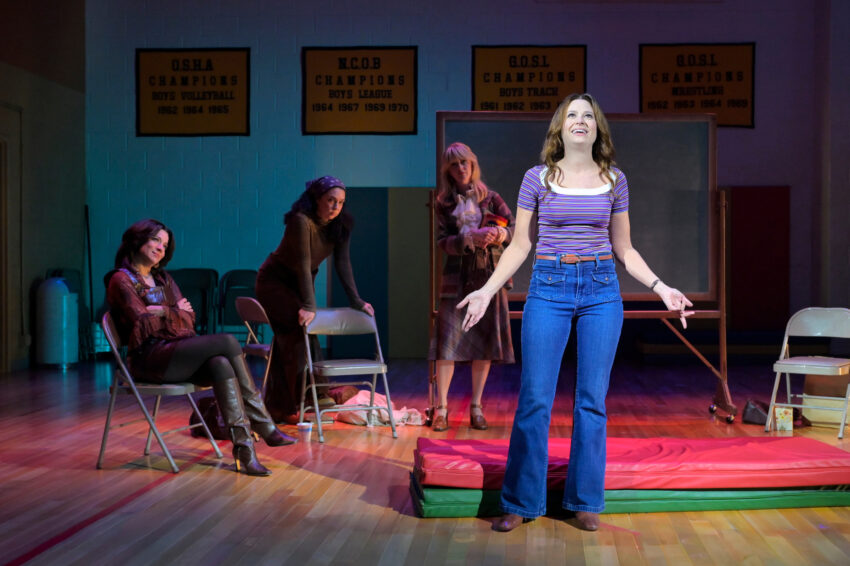
Set in a recreation hall’s basement basketball court, Ohio Boys’ Championship banners loom large next to the hoop. Six women arrive for a feminist consciousness-raising group amid the acrid smell of testosterone.

Katie Lowes plays both Lizzie and her daughter, who seeks the truth about why her mother’s feminist group “failed.” She’s curious about what happened before her mother pivoted to the Trad Wife life: marrying, raising children, and staying at home.
Lowes seamlessly moves from playing the writer’s mother, Lizzie, in the feminist group to playing her daughter. Her wry comments to the audience on the 70s scene make “Liberation” a complex memory play.
Three of the other women have incredibly compelling stories. In T-shirt and jeans, Susan (tough and tender Evelyn Spahr) can only signal, not voice, her own identity. Susan follows her Marxist ideals of eliminating class and gender divisions, while living in her car, unemployed. Her empathy for others in the group inspires our empathy for her, especially when we learn her secret.

Veronica Otim’s brief but spectacular scenes as Joanne forcefully argue for more representation for Black women. With a stunning vocal riff, Joanne breaks the fourth wall to demand more stage time.
Otim shifts to playing the playwright’s mother, so Wahl can test some answers. Joanne knows all about parenting: she has four children of her own. She’s articulate and funny, but has no time for consciousness raising.
As Celeste, a ground-breaking 60s Black grad from Radcliffe and Harvard, Felicia Curry delightfully embodies an ambitious, urbane writer. Forced to leave her beloved New York to care for her mother in Ohio, Celeste brings to mind how women bear the brunt of elder care.
Her Mom is more than a domestic worker in Ohio. She reads and reads—giving books to those who cannot afford them.

Here, we have three talented women who remind us that the feminist movement in the 1970’s was not inclusive.
Other members of the group include sexy Italian green card holder Isadora (fiery Irene Sofia Lucio). She wants action NOW. Married and trapped, Margie (convincing Mary Gordon Murray) explains how her list of chores sits next to her retired husband’s TV Guide. He checks off the shows, but never helps with the chores.
Twitchy blonde secretary Dora (delightful Britt Faulkner) rejects traditional marriage, but is not above showing a little cleavage to influence her sexist boss.
“Liberation” does not suggest how to keep the women’s movement progressing during today’s troubling times.
As elections crucial to women’s bodily autonomy loom, we can look to our WNBA Valkyries to provide hope. Their success proves that investment in women pays off in championships and more. It’s time to spread that wealth and protect women’s hard won rights, forever.
“Liberation” by Bess Wohl, directed by Whitney White, lighting by Cha See, costumes by Qween Jean, wigs & hair by Nikiya Mathis, scenic design by David Zinn, and sound by Palmer Hefferan, in a co-production with Geffen Playhouse Studio Theatre and American Repertory Theater, at Berkeley Repertory Theatre.
Info: berkeleyrep.org – to November 29, 2026.
Cast: Felicia Curry, Britt Faulkner, Katie Lowes, Irene Sofia Lucio, Gunnar Manchester, Mary Gordon Murray, Veronica Otim, and Evelyn Spahr.
Banner photo: Katie Lowes & Ensemble. Photos by Kevin Berne