“Arab Spring” Wrestles with Tradition vs. Modernity—at Golden Thread
Playwright Denmo Ibrahim Spotlights Immigrant Family Conflicts
by Zack Rogow
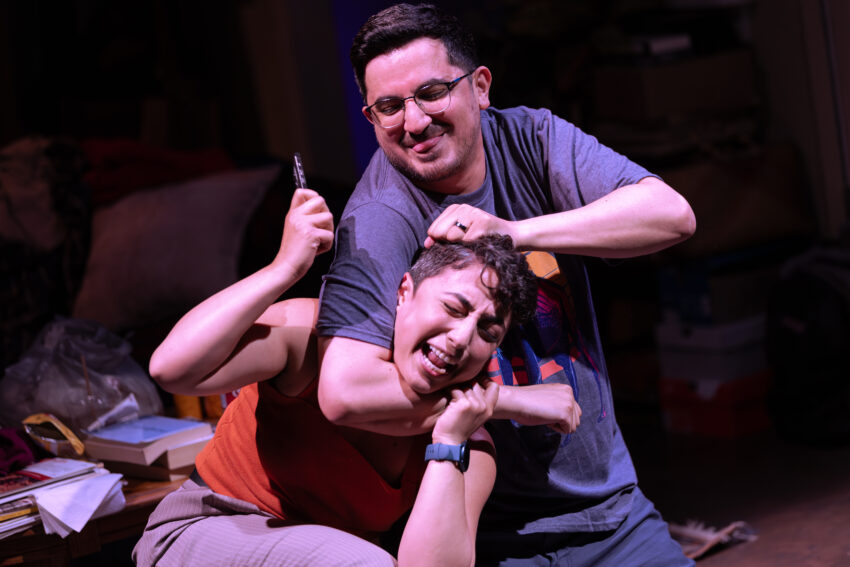
In Denmo Ibrahim’s “Arab Spring,” a brother and sister literally wrestle with their recently deceased father’s ringing cellphone. Their tussle offers a dramatic symbol of traditional culture vs. modern American life, as they struggle for the phone.
Estranged sister Dina (Arti Ishak) left behind her Muslim and Arab traditions. Dina is a successful corporate lawyer, a lesbian, and lives across the country from her family. Her brother, Yusef (Salim Razawi), stays behind in Houston to run the family store and raise children with his wife. He’s also struggled with addiction and depression.
Dina and Yusef’s dilemmas resonate with the immigrant experience more broadly. How much tradition can you hold onto? How much to jettison for a free and modern life? What’s new is to see these issues through an Arab American viewpoint.
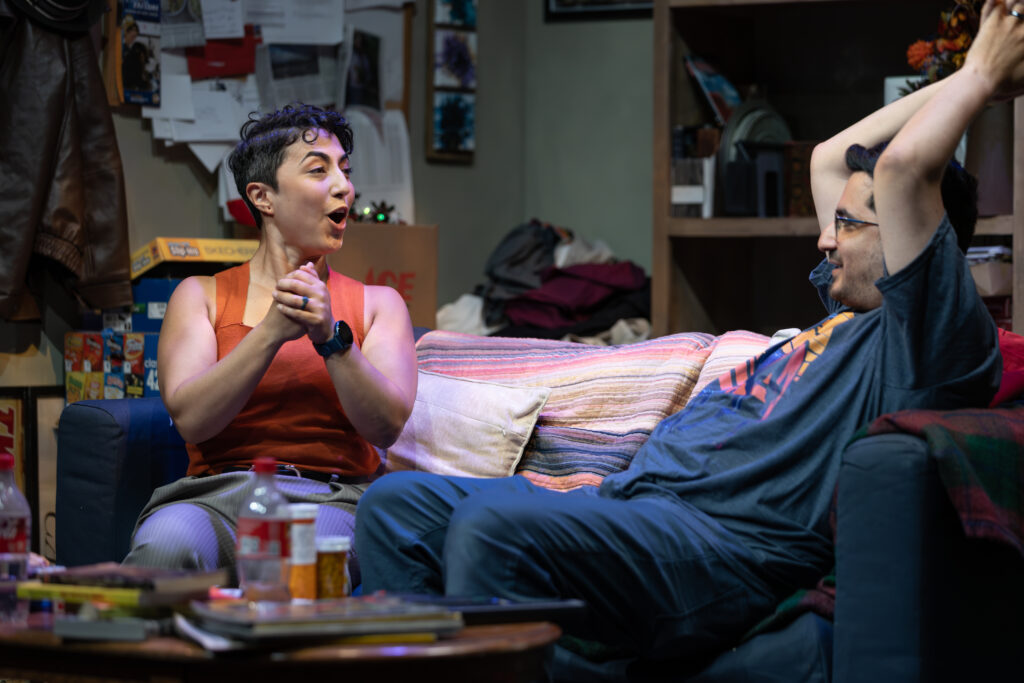
As the siblings sift through their father’s belongings on the eve of his funeral, they unearth cassette tapes of their dad reflecting on his youth. Those recordings, voiced by Khaled Abol Naga, provide tantalizing clues to what provoked the father to flee Egypt.
The action takes place on July 4, with fireworks exploding in the background, a reminder of American political realities. Texas summer heat is a constant in this play, which makes the title, “Arab Spring,” seem like a puzzling choice.
Salim Razawi is a natural as Yusef, who takes for granted his older brother privileges—including having received a sports car as a 16-year-old birthday gift. But the brother’s role is confusing because Yusef first appears as a clueless buffoon, but turns out to be the family mainstay.
As Dina, Arti Ishak transforms from someone focused on herself as the victim of her unfair treatment in childhood, to someone who reflects on what still matters about her family roots.
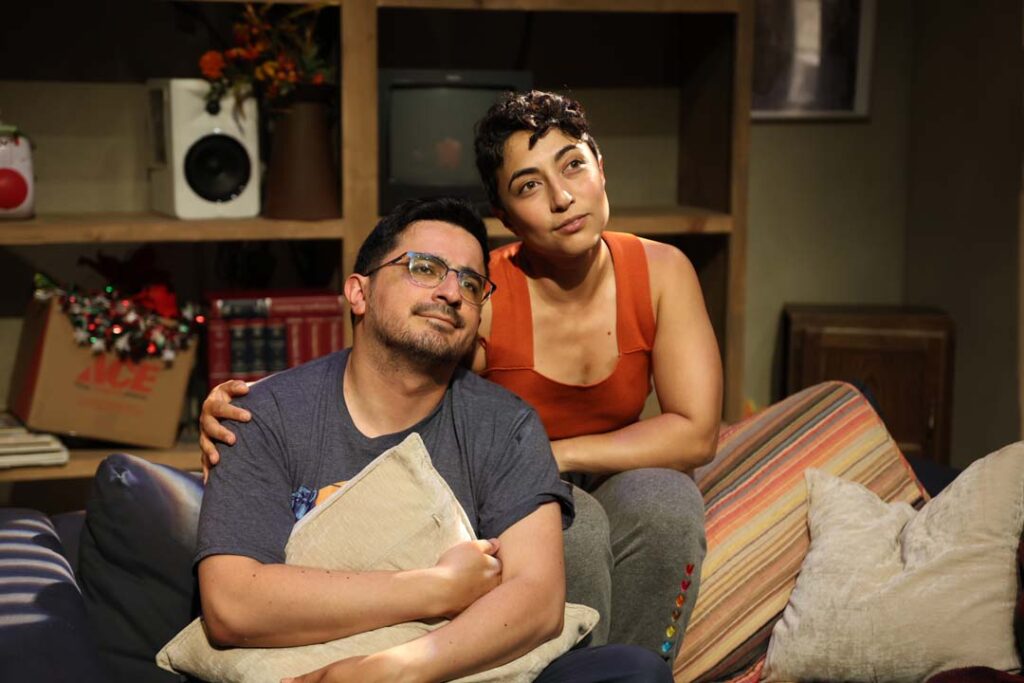
The actors are at their best in the scenes where they find common ground. When brother and sister dance to ’80s music, they reach a deeply moving moment.
Director Nailah Unole dida-Nese’ah Harper-Malveaux, scenic designer Mikiko Uesegi, and props designer Heidi Button recreate an immigrant U.S. home that reflects a family’s legacy. Since Dad was a hoarder, about 100 props fill the stage. The layers of clutter draw us deeper into the heart of this family.
“Arab Spring” is a co-production of Golden Thread, the nation’s first theater company dedicated to the Middle East, and SFBATCO. A large and multitalented team collaborated to bring this production to the theater, including a fight choreographer and numerous tech professionals, who all contributed to a well-staged play.
The next step would be to streamline and tighten the plot. Playwright Denmo Ibrahim can fill in the gaps that surround her characters to bring on the heightened emotions just below the surface.
“Arab Spring” by Denmo Ibrahim, directed by Nailah Unole dida-Nese’ah Harper-Malveaux, scenic design by Mikiko Uesugi, costumes by Buffy Yahyaa, lighting & video by Sinjin Jones, sound by Michael Kelly, by Golden Thread Productions & SFBATCO, at Potrero Stage, San Francisco.
Info: goldenthread.org – to July 12, 2026.
Cast: Salim Razawi and Arti Ishak.
Banner photo: Egyptian-American siblings Yusef (Salim Razawi) and Dina (Arti Ishak). Photos by Jared Randolph
Zack Rogow is a playwright, poet, and literary translator based in Berkeley.