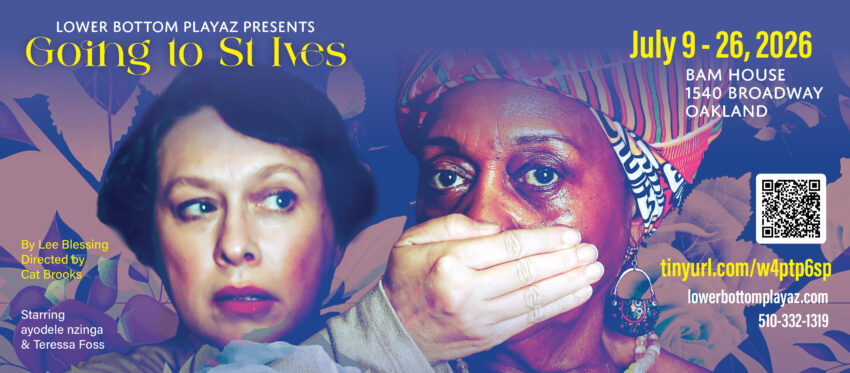
“Going to St. Ives” Where the Black Theater Movement Tackles Colonialism—at LBP
Lee Blessing Conjures Two Powerful Women Tangled in Cultural Conflict
by Kheven Lee LaGrone
According to Director Cat Brooks, the Lower Bottom Playaz does not simply entertain, they try to give a voice to their community. They also offer young people an opportunity to participate in live theater.
Founded 27 years ago, Lower Bottom Playaz started with grassroots productions in the backyard of a West Oakland Victorian, growing from the Black Theater Movement of the 60s and 70s. Today, they still tackle the challenges for Black America that mainstream theaters will not touch. Their latest production, Lee Blessing’s “Going to St. Ives” shows that they have not lost their heart.
“Going to St. Ives,” a biting two-woman play about women and power, opens with May N’Kame (Ayodele Nzinga) in the drawing room of an old English home. Regal and imposing in her boldly colored, formal African attire, N’Kame wields power as the mother of an African emperor.
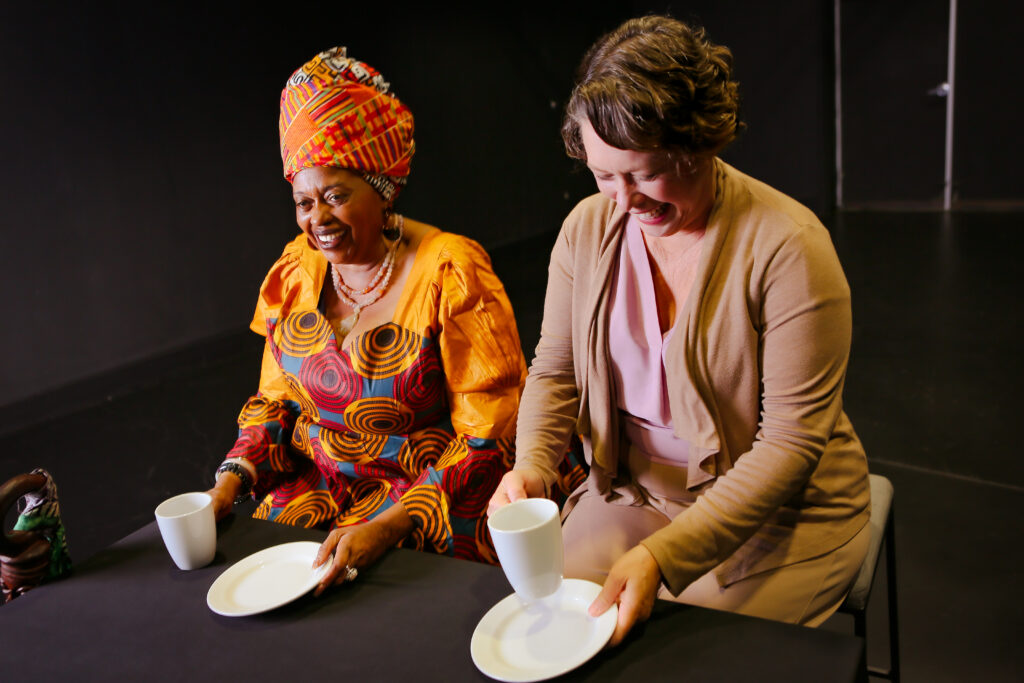
When N’Kame visits Dr. Cora Gage (Teressa Foss), she impresses the British doctor. N’Kame is also impressed with Dr. Gage’s reputation as a miraculous eye doctor. She comes to England seeking treatment for her failing eyes.
Her son, the emperor, asserts, “None of our people may touch her [his mother]. She must be treated by the doctor who teaches doctors to teach other doctors.” Here, we see basic misunderstandings caused by colonialism.
Playwright Blessing sets up a confrontation between the two cultures. The powerful women represent the colonized versus the colonizer. N’Kame’s power comes through marriage and motherhood, while Dr. Gage has earned hers through study. In addition, N’Kame believes that, as a doctor, Dr. Gage has the power to end lives, as well as preserve them.
Dr. Gage argues that N’Kame’s son, as dictator of a “repressive regime,” has killed and tortured thousands of people. The English doctor believes that N’Kame should intervene to save more lives.

The conflict in “Going to St. Ives” comes to a boil when each woman asks the other one to grant a favor that is both political and personal. Both women believe their requests are moral and responsible. N’Kame asks Dr. Gage to use her medical “power” to aid in a political killing, which she justifies because the British have a history of killing colonized people.
Dr. Gage argues, “I will not accept this. Whatever the colonial rule was, it was not an open invitation to savage acts.” When N’Kame persists in her request, Dr. Gage responds:
You want me to risk my career, my reputation, my life, for a country like yours?
For God’s sake, how many countries are in Africa? And they’re all unpronounceable,
unimprovable, soaked in their own blood. Who’s good? Who’s bad? Why should I care?
Those words sting. They don’t just entertain; they open our eyes. Most theaters seem to avoid such controversial dialogue. But Director Brooks does a wonderful job bringing the thought-provoking script to life.
Both Nzinga and Foss are excellent in their confrontation. As their characters disagree on issues ranging from white supremacy to motherhood, the tension mounts to a surprising climax. Lower Bottom Playaz delivers the dramatic conflict boldly. Thumbs up!
LBP’s woman-powered production proves that grassroots community theater can be more exciting than big, commercial productions. I enjoyed this meeting of opposing world views.
“Going to St. Ives” by Lee Blessing, directed by Cat Brooks, sound design by Jules Indelicato, lighting design by Stephanie Ann Johnson & Ashley Munday, scenic design by Stephen Jones, by Lower Bottom Playaz, at BAM House, 1540 Broadway, Oakland, California.
Info: lowerbottomplayaz.org – to July 26, 2026.
Cast: Ayodele Nzinga and Teressa Foss.