
“Girl, Interrupted” Exposes Machinery of Madness—at The Public
Majok & Mann’s Musical Probes Psychosis & Privilege
by David Moore
As an emergency physician who initiates involuntary psychiatric admissions, I was intrigued to see the process unfold onstage. “Girl, Intrerrupted,” a new musical, based on Susanna Kaysen’s 1993 memoir, holds a mirror up to me, too.
Pulitzer Prize winner Martyna Majok has written a stunning adaptation, with original music by Aimee Mann. Manoel Feliciano plays a psychiatrist who makes decisions about his patients’ liberty with incomplete information—after a fifteen-minute evaluation—making us cringe.
Using a sparsely set stage, Majok takes us back to McLean Hospital in Massachusetts in 1967. A single round column descends from the ceiling, a focal point for the women confined to the asylum. They gather round to receive medicine or watch TV, where civil rights battles, ironically, are unfolding. Bars of a cage surround the column, suggesting the confusion between care and confinement.
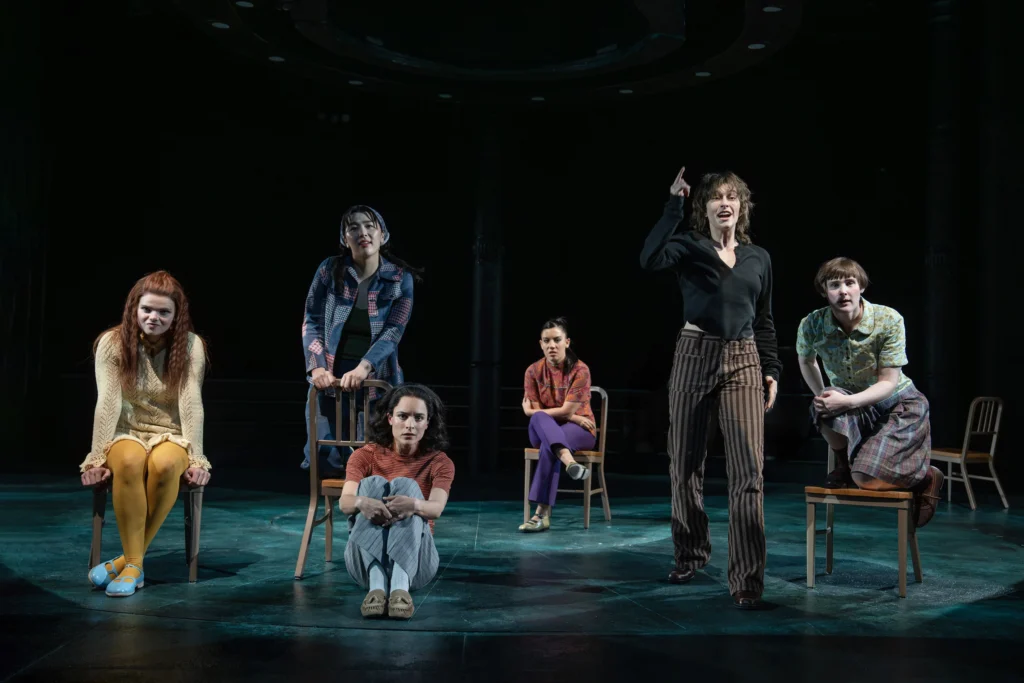
Mental illness in “Girl, Interrupted” is shaped by gender and class. For most Americans, McLean would be an impossible luxury: a Harvard-affiliated refuge for affluent women who resist or defy patriarchal expectations. Majok makes clear that while these women are confined, they are also protected in ways that poorer women will never know.
Susanna Kaysen, committed after a serious overdose, was stuck there for eighteen months. Although Susanna’s pain and dysfunction were real, her eventual release depended on embracing a socially acceptable version of femininity, a marriage proposal.
Captivating and stately Juliana Canfield plays Susanna, a strong-willed, bewildered, but composed narrator. Canfield adds details to Susanna’s mental illness, and we begin to doubt her rushed “diagnosis.”
Then we witness her psychotic break. She writhes on the floor and bites her hand until it bleeds. Sedatives are forced into her mouth. Her outward composure masked her psychosis, and her illness abruptly surfaces.
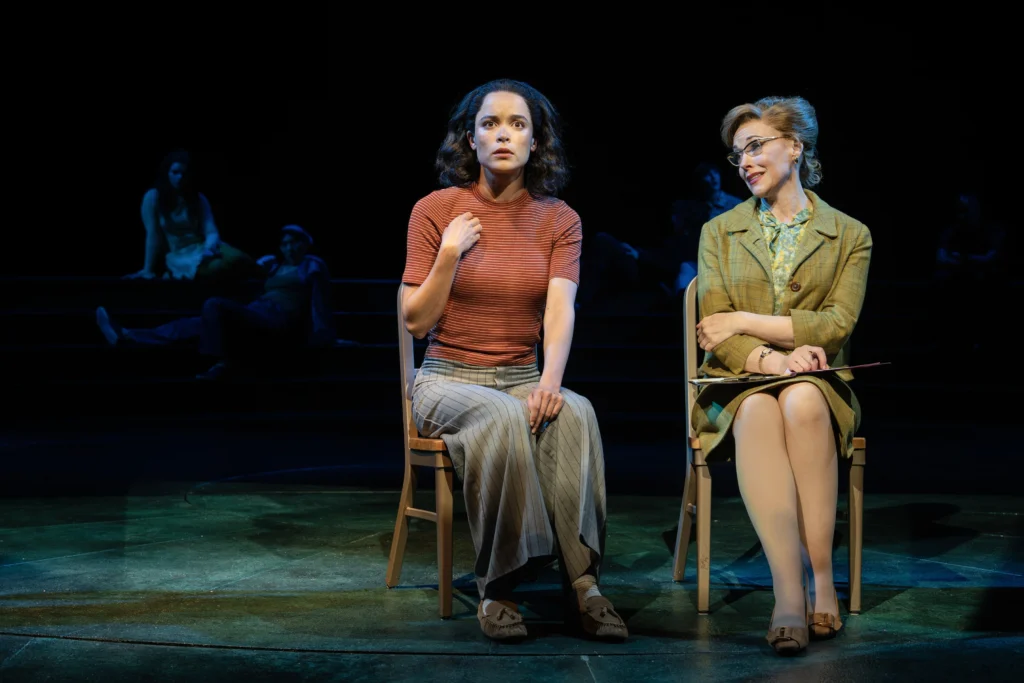
In the wards of McLean, we meet lost women who are trying to connect with each other and find space to heal. King Princess plays Lisa, the group’s live wire, a self-declared “psychopath” with rock-star hair. Lisa’s coiled energy depicts a young woman yearning for belonging. But instability traps her in the asylum.
The institution gives labels to the women, pins them like specimens, and calls that treatment. In an early scene that stops the play cold, each woman delivers her own diagnosis. Lisa grins, proclaiming, “I’m a psychopath.” Susanna alone stays silent. She will not know her actual diagnosis for twenty years.
Majok has based her book on Mann’s 2021 album Queens of the Summer Hotel. The songs illuminate emotional states beyond dialogue. Endearing Gabi Campo plays forlorn Tori whose song “Mexico” conjures mental anguish amid tropical luxury:
Big veranda, stately trees
Servants bring me fruit and cheese
Flowers bloom and feed their bees
Underneath the Sword of Damocles
As Polly, another patient, Sally Shaw delivers a quiet revelation. Cheerful on the surface and possibly neurodivergent, Polly arrives at a disturbing sense of peace. In the hauntingly beautiful “Burn It Out,” she contemplates a terrible act in a world that has stripped women of control. Shaw’s understated precision is chilling.
“Girl, Interrupted” is searing, compassionate theater, lifted by superb performances and Mann’s haunting songs. The musical gets under your skin to expose long-hidden truths.
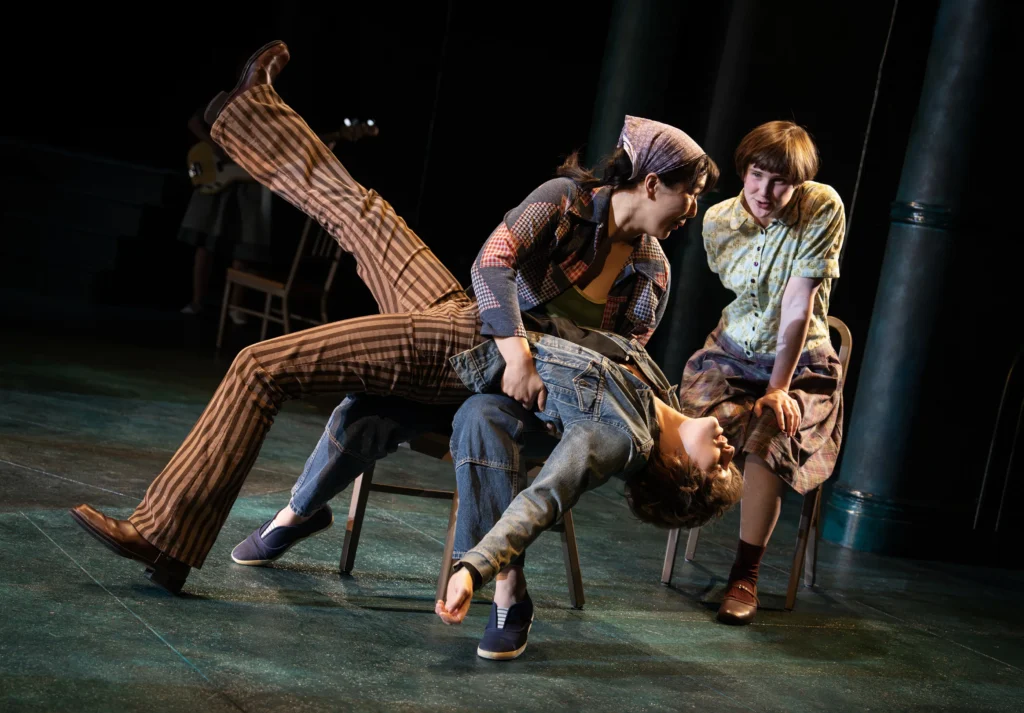
“Girl, Interrupted” –book by Martyna Majok, based on the book by Susanna Kaysen, music by Aimee Mann, choreography by Sonya Tayeh, directed by Jo Bonney, scenic design by dots, at The Public Theater, New York City.
Info: publictheater.org – to July 12, 2026.
Cast: Ta’Rea Campbell, Gabi Campo, Juliana Canfield, Manoel Felciano, King Princess, Mia Pak, Katherine Reis, Ally Shaw, Emily Skinner, and Lauren Jeanne Thomas.
Banner photo: Ta’Rea Campbell, Juliana Canfield, and Lauren Jeanne Thomas. Photos: Joan Marcus