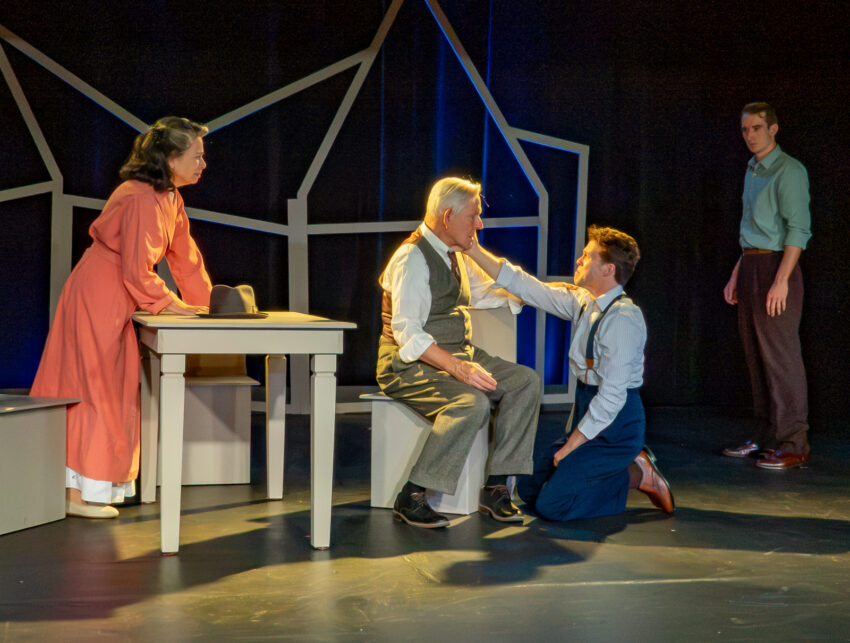
“Death of a Salesman” Masterfully Unmasks American Illusions—at Ross Valley
Arthur Miller Powerfully Mixes Fantasy & Truth
by Raffaele Antonio Scullari
Sitting in the dark, watching Arthur Miller’s “Death of a Salesman,” it hit me: this isn’t just some dusty old 1949 classic about the so-called American Dream. It’s a raw, intimate look at a father and son who love each other, but are lost in empty promises.
The heart of the heartbreak is Willy Loman (thoughtful Charles Queary). We all know Willy—the guy convinced that a great smile will deliver keys to the kingdom. He tells his boys: “Be liked and you will never want.”
At first, we want to laugh at Willy’s illusions; he extols popularity as a superpower. We watch him slowly crack under a salesman’s life, as our laughter becomes an uncomfortable knot of sympathy. He’s an ordinary guy lying to himself just to survive.
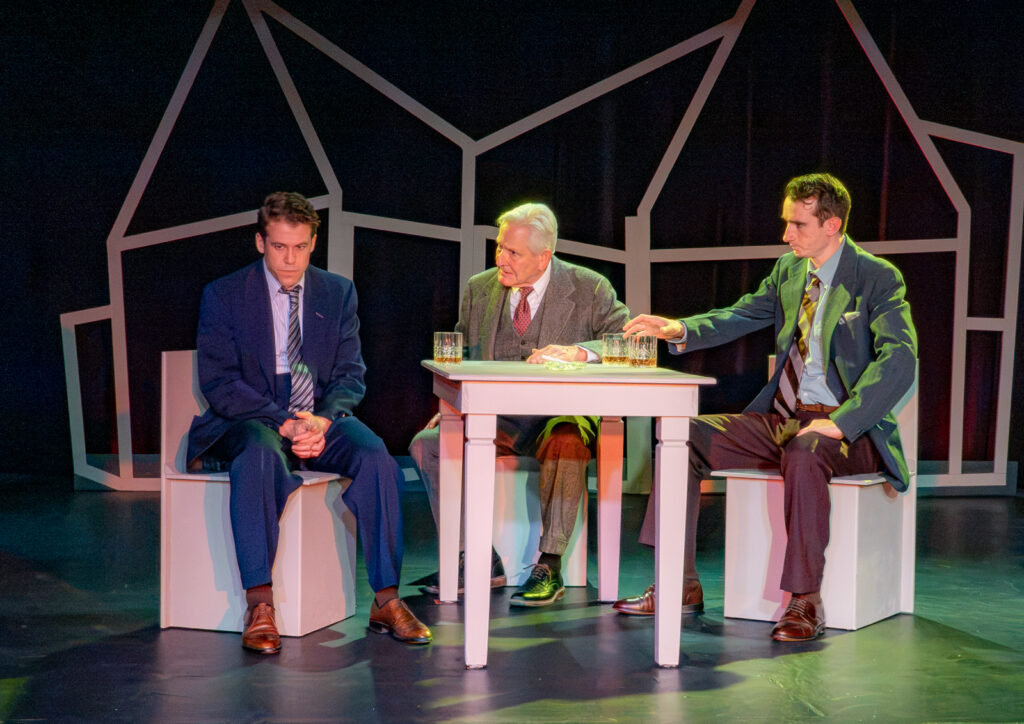
Willy’s older son Biff (captivating Brennan Pickman-Thoon) struggles with his father’s delusions. Willy raised Biff to believe he was destined to conquer the world. In contrast, Biff’s younger brother Happy (engaging Evan Held) has tied himself to the Dream.
As an adult, Biff is suffocating. He doesn’t want the corner office, or the relentless corporate hustle that Willy imagines for him; he just wants an honest life, close to nature. But Biff is trapped by a father who refuses to understand his son.
Pickman-Thoon does a masterful job portraying Biff’s desperate attempts to escape Willy’s impossible standards. The tension erupts in the most powerful moment of the play: Biff finally breaks down and screams, “I’m a dime a dozen and so are you!” Biff isn’t just angry; he’s begging. He’s pleading with his father to realize that being down-to-earth and honest is not failure.
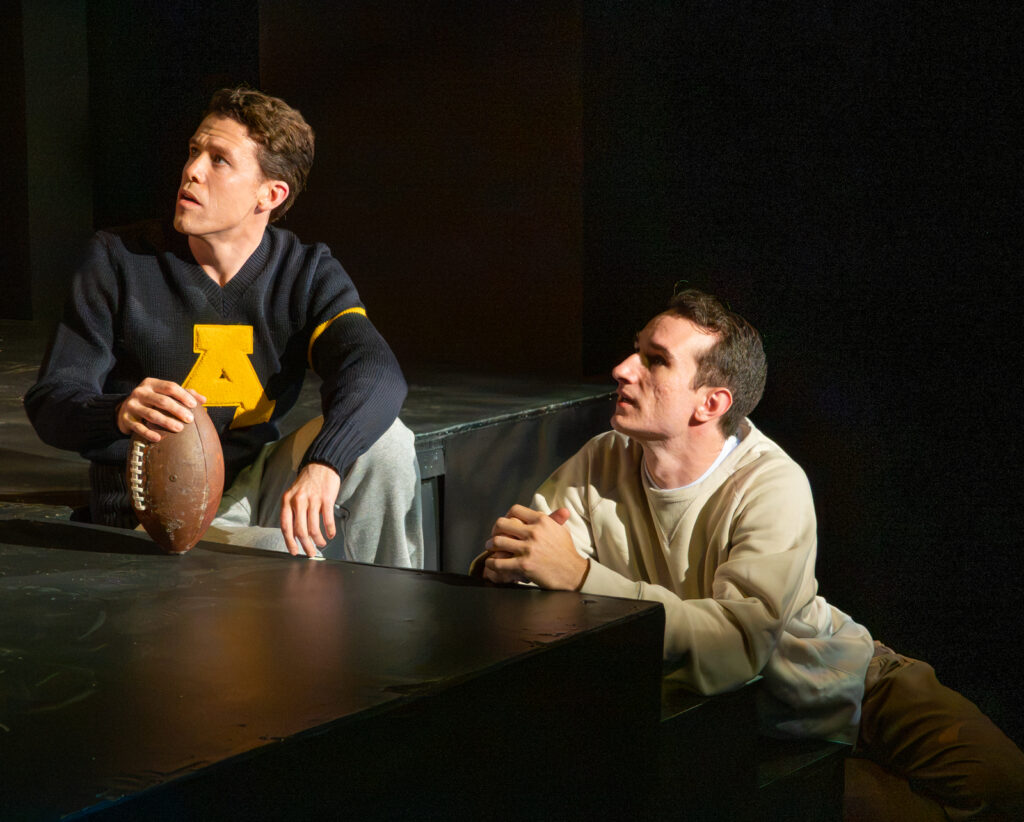
The family and friends caught in their crossfire make this “Salesman” even more tragic. Linda Loman (keen understudy Amanda Vitiello) is fiercely protective, barely holding her crumbling husband together. But her blind support enables his downfall. The tragedy is reinforced in sparkling performances by William Brosnahan, D.J. Hardy, Rachel Ka’iulani Kennealy, Isadora Zucker, and Ilana Niernberger.
Next-door neighbor Charley (impressive Steve Price) represents the stability Willy might have found if he realized that the Dream is an illusion. Charley, practical and comfortable with himself, doesn’t need to impress anyone. Price perfectly depicts a generous neighbor willing to help.
Willy fantasizes about his older brother Ben (understudy Greg Wilker), as the epitome of the capitalist adventurer. Ben represents the seduction of the “American Dream.”
Back in reality, Charley’s son, the awkward neighbor kid Bernard (inspired Christopher Jensen) finds real-world success. Bernard proves that Willy’s theories about popularity are completely wrong.
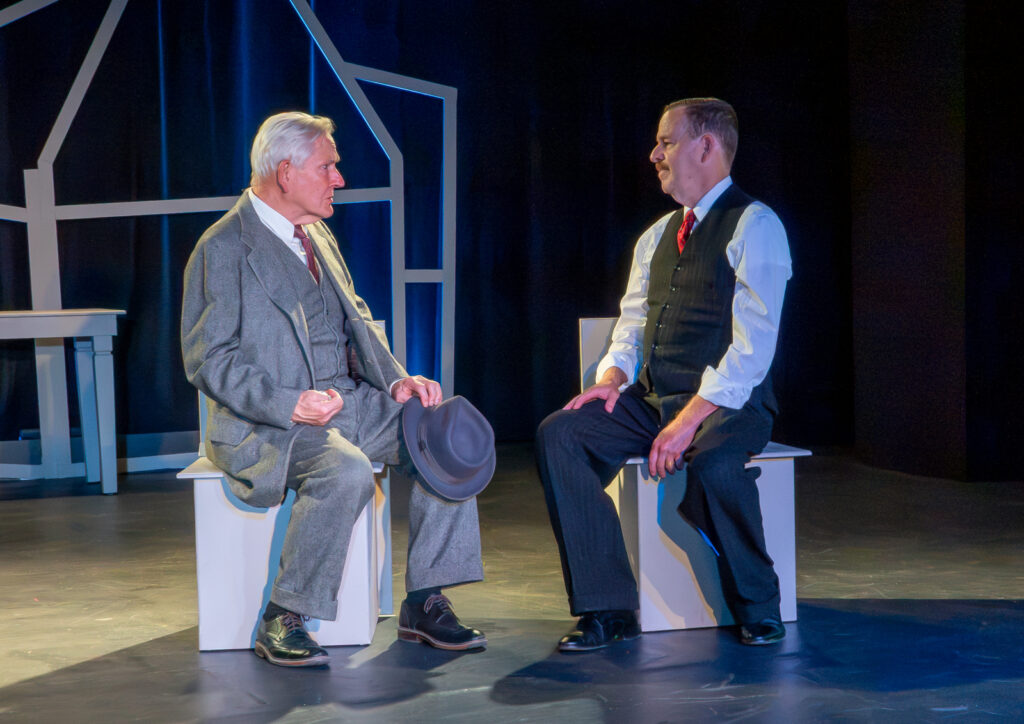
Leaving the theater, I thought about how much of Willy’s life is spent on chasing someone else’s idea of success. He’s so afraid of being “ordinary” that he rejects the love and support already around him.
Arthur Miller questions an American Dream that promises opportunity, but cannot guarantee fulfillment. Biff offers a new view, where self-fulfillment is better than “success.” I left wishing Willy could have accepted his son’s vision.
Don’t miss this profound “Salesman” that measures fake success against true happiness.
“Death of a Salesman” by Arthur Miller, directed by Adrian Elfenbaum, set design by Ron Krempetz, costumes by Valera Coble, lighting by Robin Deluca, and sound by Alexis Brooks/ Brooklyn Sound Lab, by Ross Valley Players, Ross, California.
Info: rossvalleyplayers.com – to October 25, 2026.
Cast: Charles Queary, Mary Ann Rodgers, Brennan Pickman-Thoon, Evan Held, Steve Price, Christopher Jensen, Mark Robinson, William Brosnahan, Ilana Niernberger, Diego Hardy, Rachel Kai’ulani Kennealy, and Isadora Zucker.
Banner photo: Mary Ann Rodgers, Charles Queary, Brennan Pickman-Thoon, & Evan Held. Photos: Robin Jackson