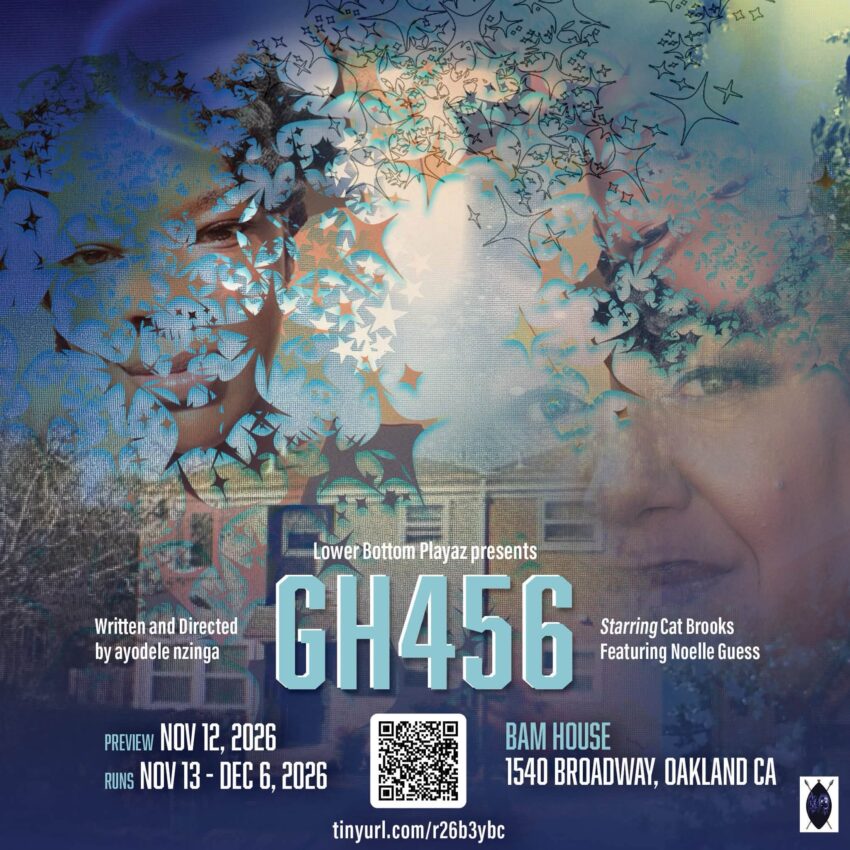
“GH 456” Uses Black Activism to Foretell Future—at LBP
Ayodele Nzinga Charms with Song, Dance, & Afro-Futurism
by Kheven Lee LaGrone
Today, stories about cyberattacks on banks, the CIA and FBI, data centers, and airlines nationwide fill the news. The stories reveal that technology runs the world—not people.
Lower Bottom Playaz in Oakland, part of the Black Arts Movement, has conceived a new play, “GH 456,” to explain our future. The play opens in 2042, when the United States of Global Institution rules the Earth. Artificial intelligence machines run the Institution. Playwright and director Ayodele Nzinga’s “GH 456” could be prophetic.
Following her earlier play “Government Housing,” Nzinga’s “GH 456,” an experimental, semi-autobiographical play, nicely melds community activism with futurism. The women-led production confronts institutions that claim to support their disenfranchised clients, but further disenfranchises them.
While “Government Housing” was metaphysical, “GH 456” is factually futuristic. Waiting for the play to start, I learned a lot from the helpful program. At the end of “Government Housing,” Dele (Noelle Guess) and Housing Worker (Cat Brooks) are being transported to Black Eden. In “GH 456,” their travel is intercepted by the Institution.
Two large monitors, acting for the establishment, hold the two women hostages. The machines keep saying they want to help the women. In fact, they interrogate them to locate and colonize Black Eden for the Institution.
In “Government Housing,” Housing Worker had no name because she had been a faceless, nameless tool of the bureaucracy. But the authorities have betrayed her by simply abolishing her job. Cat Brooks conveys frustration and anger. She explodes. She simmers. She adopts a stone-face, looking beaten down. I forgot she was an actor: she made be a believer.
Dele, who identifies herself as Subject B, was part of House Worker’s case load. After a while, Housing Worker remembers her. But Dele is not the person Housing Worker thinks she is. Noelle Guess smartly plays Dele in a robotic coma, contrasting with Housing Worker’s emotional state.
“GH 456” lacks action, but music and dancing steal the show. If the story is stark and inhuman, the music and dance call on the human spirit. We want more of that confrontation.
Impressively, Nzinga has also composed the music. Takiyah Franklin beautifully sings her lyrics. Talented Jameelah Lane and Brianna Franklin offer intriguing dances to accompany the songs, highlights of the show.
With Franklin performing a couple more songs, this could be an engaging, heartfelt musical. But “GH 456” is not entertainment to medicate us. It’s alerting us to a dangerous future.
“GH 456” packs the power of music and cultural criticism in one tight package. Nzinga gives us plenty to think about our world and where we’re going. Time now to join her in shaping tomorrow.
“GH 456”—written & directed by Ayodele Nzinga, scenic design by Stephen Jones, set construction by Jamila Ring, and sound by Daniel Wall, by Lower Bottom Playaz, at BAM House, Oakland.
Info: lowerbottomplayaz.com – to December 6, 2026.
Cast: Cat Brooks, Noelle Guess, Jameela Lane, and Brianna Franklin.